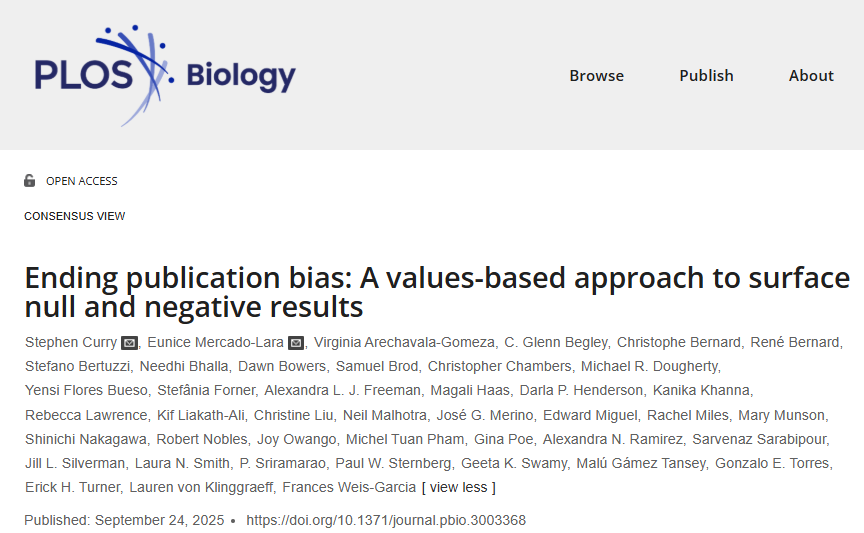
I am delighted to share a publication I recently co-authored: Ending publication bias: A values-based approach to surface null and negative results, just published in PLOS Biology. This paper is the outcome of a two-day workshop in Bethesda, USA, hosted by the NINDs in 2024, which I had the honour to attend alongside colleagues from many disciplines and parts of the world.
The consensus we reached is simple, yet urgent: if science only rewards and publishes “positive” or “impactful” results, then we are not doing good science. We are leaving vital knowledge in the drawer — results that tell us which avenues don’t work, which hypotheses have been tested and ruled out, which drugs or models are not worth pursuing. Not sharing this knowledge slows down research, wastes resources, and, most importantly, hampers our ability to solve critical problems such as finding cures for rare diseases, a cause very close to my heart.
This is not a new concern for me. At Naukas Bilbao 2023, I dedicated this science communication talk to this very issue. In those nine minutes, I spoke about the obsession with “excellence” in research and the low value we assign to “negative” results or to replication studies. I called then — and call again now — for a shift in how we assess science: not by the perceived impact of the outcome, but by the quality of the process. To know where not to go is just as important as knowing the path forward.
I strongly encourage you to also read Stephen Curry’s blog post reflecting on our paper, Let’s Get Negative, which captures the spirit of our work and why this conversation needs to spread widely across the research community.
Science should be open, transparent, and rigorous. Sharing all results — positive, negative, or null — strengthens trust in science and accelerates discovery. I am proud that our publication sets out a values-based roadmap for funders, institutions, publishers, and researchers to make this cultural shift possible.
For me, this is more than a publication. It is a call to action for all of us to rethink how we value and share scientific work. Because if we let bias silence results that don’t fit the expected narrative, we weaken our chances of making the breakthroughs that society urgently needs.